
Overview
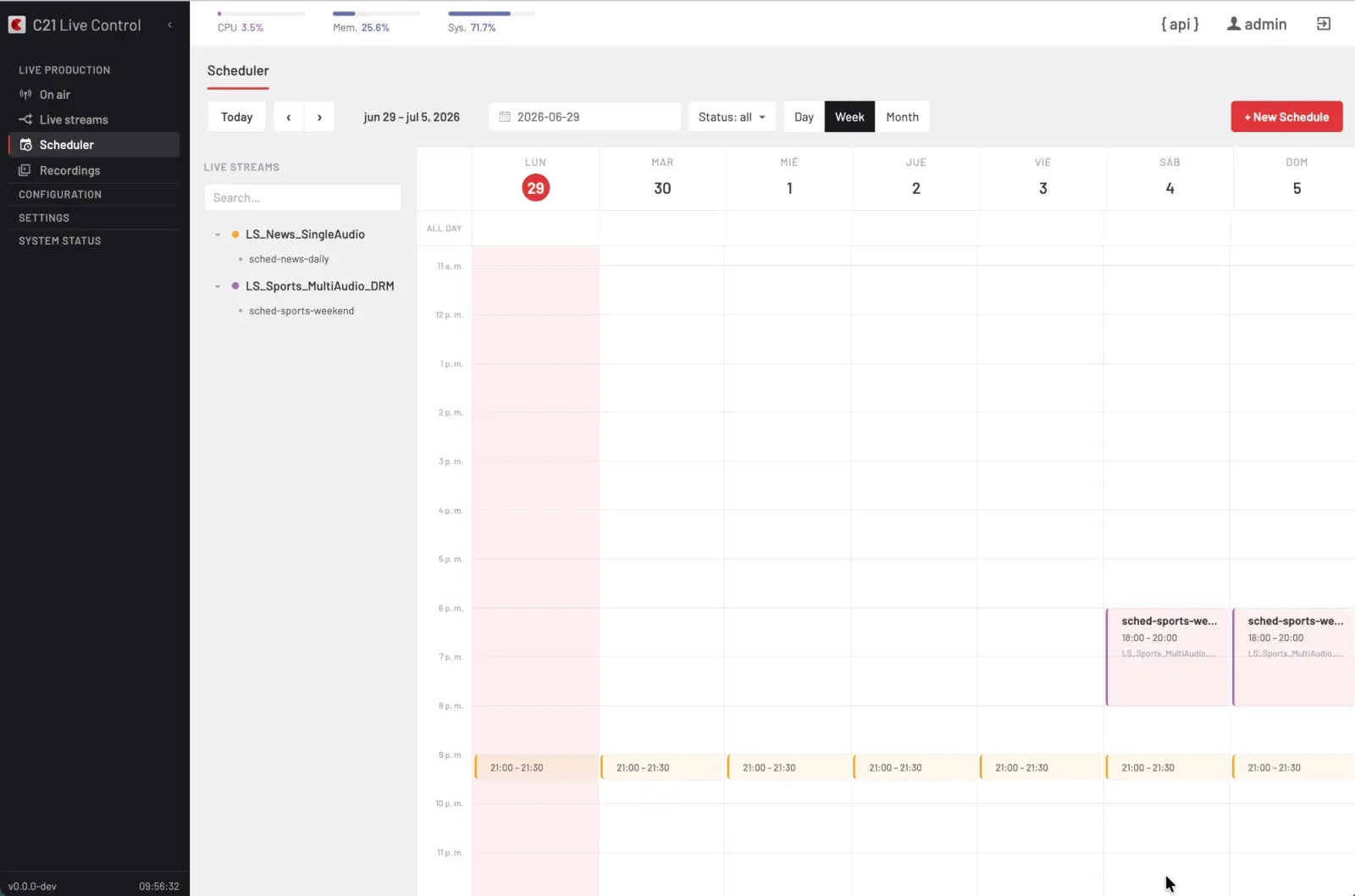
The Scheduler is the calendar view where Schedules are planned. Each Schedule binds a Live stream to a start time, an end time, an encoder Device (or Device group) and an optional recurrence. The Scheduler fires the start and stop transitions on the bound Live stream when the time comes.
What you see
The Scheduler page exposes:
- A toolbar with: the + New Schedule and + Planned actions actions (top right), the period navigation (
Todayplus the arrows), a date picker, the Status: all filter, and the Day · Week · Month view switcher. - A calendar grid that renders each Schedule as a coloured event on the time axis.
- An empty state — "No schedules found" — when the current view has no Schedules.
Creating a Schedule
Open New Schedule
Click New Schedule in the toolbar. The dialog is grouped into four blocks: Information, Date and Time, Recurrence and Live stream.
Information
Set:
- Name — the Schedule's display name.
- Live Stream — the Live stream the Schedule will drive.
- Enabled — disable the Schedule without deleting it.
Date and Time
Set the Start and End timestamps. The API rejects starts earlier than 10 minutes in the past, and the date pickers grey out earlier dates accordingly. Times are in the time zone of the Live Control installation — see Time zone.
Recurrence
Pick one of the recurrence options. The set is exactly what the API exposes:
| Option | Meaning |
|---|---|
| None | One-shot, no repetition (default). |
| Daily | Repeats every day at the same time as Start. |
| Weekly | Repeats every 7 days from Start (every Monday if Start is a Monday — not "weekdays only"). |
| Workdays | Repeats every weekday (Monday through Friday). |
| Weekend | Repeats every Saturday and Sunday. |
The interval field of the recurrence is reserved for future use and currently treated as 1 regardless of the value sent.
Live stream block
The dialog surfaces the selected Live stream's bindings (Channel, Encoding, Destination) and exposes the Encoder / Encoder group picker plus the Master settings. Submitting the dialog persists the Schedule and lets C21 Live Control dispatch it when the start time comes.
Time zone
Every Schedule time is wall-clock time in the time zone of the Live Control installation (set at install time). Through the API (addSchedule, updateSchedule):
- A time with
Zor an explicit offset —2026-10-08T12:15:00Z,2026-10-08T14:15:00+02:00— is an instant: it is converted to the installation's time zone before it is stored. This is the safe choice for integrations. - A time without an offset —
2026-10-08T14:15:00— is read as local time in the installation's time zone. - Responses always return local time without an offset (
YYYY-MM-DDTHH:MM:SS). - An empty date is rejected.
Day-based rules — the Workdays and Weekend recurrences, the end of a series and skipped dates — use the installation's calendar day: 2026-10-08T23:30:00Z is Thursday in UTC but Friday 01:30 in Madrid, and the Friday is what counts there.
Destinations of a Schedule
A Schedule stores its own Destination matrix: which members of the Live stream's Destination groups it switches on, and with which renditions. The matrix is applied as stored when the Schedule fires.
- A Schedule created without a matrix switches on every member of the Live stream's Destination groups.
- In the API, the matrix is
config.startConfigonaddSchedule/updateSchedule, with the same shape as the start configuration of a Live stream. Members left out of a non-emptystartConfig, and members listed withdestinations: [], stay off for this Schedule but keep their renditions, so switching them on later publishes. encodingsomitted gives the member every rendition of the Encoding group; an empty list gives it none; a list keeps that selection.- On
updateSchedule, a non-emptystartConfigreplaces the whole matrix. Omittingconfig, or sending an emptystartConfig, leaves the stored matrix as it is. - A Destination added to a Destination group later enters switched off in every existing Schedule that uses the group; only a new matrix switches it on.
Schedule status
Schedule.status is an integer:
0— pending (the Schedule has not fired yet).1— active (the Schedule has fired and is driving the Live stream).99— deleted.
A Schedule that is active also surfaces on the bound Live stream (automatic = true). Stopping a Live stream that was started by a Schedule shows the additional dialog line "The associated Schedule will be deleted." — see Start and stop.
Cancelling occurrences in a recurrence
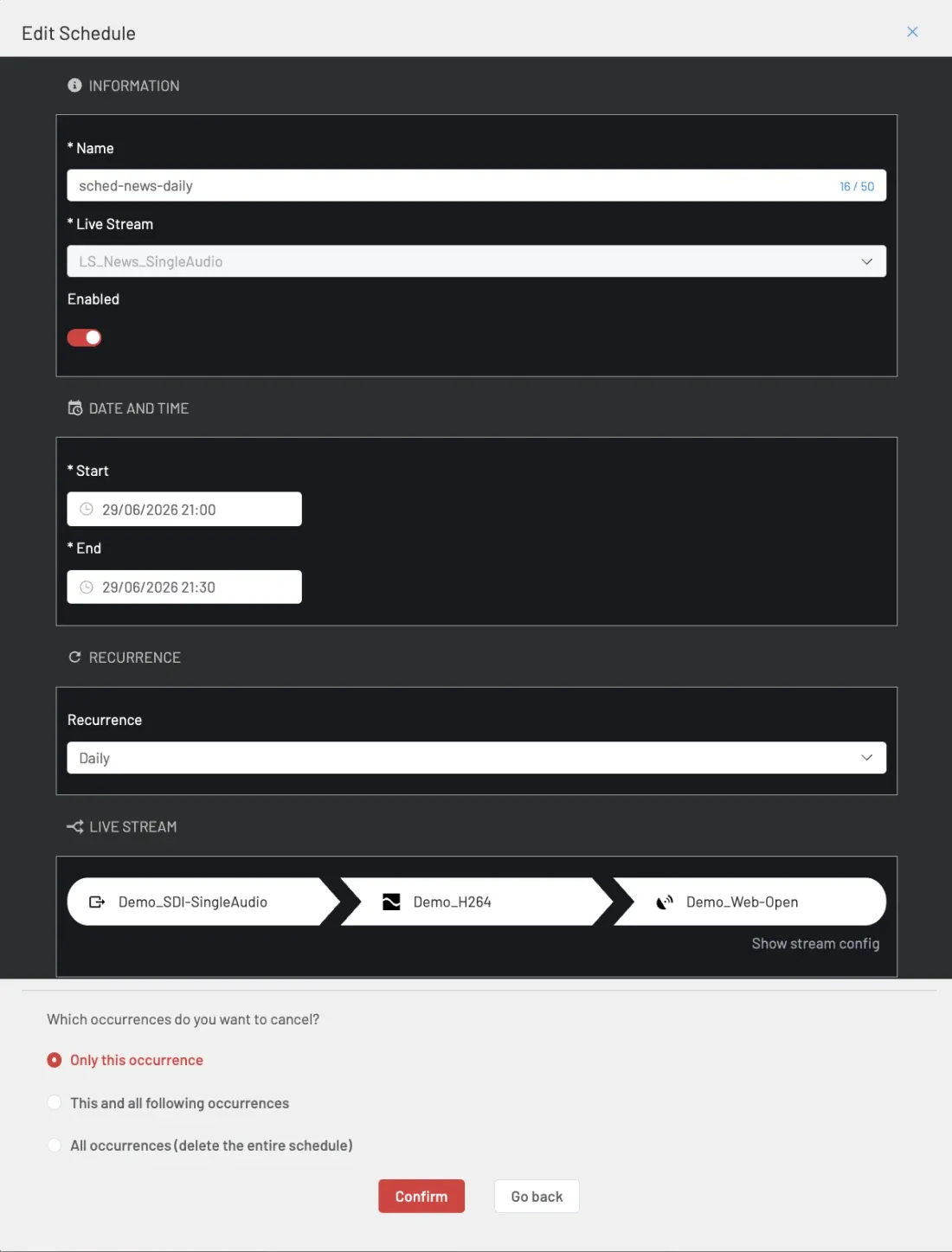
A recurring Schedule produces one occurrence per repetition. You can cancel — or skip — a single occurrence without deleting the whole series. Click the occurrence on the calendar to open the Edit Schedule dialog and press Delete: the scope selector "Which occurrences do you want to cancel?" appears.
| Scope | Effect |
|---|---|
| Only this occurrence | Cancels just that date. It is reversible: the occurrence is marked as cancelled on the calendar (struck-through amber chip) and you can restore it while it is still in the future. |
| This and all following occurrences | Ends the series from that date onward. Earlier occurrences are kept; from the selected date on, nothing is scheduled. |
| All occurrences (delete the entire schedule) | Deletes the whole Schedule. It shows an extra confirmation — "Delete schedule "…"? This action cannot be undone." — and cannot be undone. |
Confirm with Confirm or dismiss the selector with Go back.
Restoring a cancelled occurrence
A cancelled occurrence that has not yet come opens a read-only view (Skipped Occurrence) with the notice "This occurrence was skipped" and a Restore occurrence button that returns it to pending. A skip that has already been consumed (a past date) cannot be restored: the dialog shows "This skip has already been consumed and cannot be restored.".
Schedule in progress
A Schedule on air ends when its End is reached. To end it earlier, bring the End forward:
- One-off Schedule. Pressing Delete while it is on air does not delete it; the dialog explains "This schedule is on air: deleting it would stop the broadcast, so it was not deleted. To end it, bring its end time forward." and offers End now. A second confirmation — "This ends the broadcast now. Bring the end time of "…" forward to now?" — sets the End to the current time and the broadcast stops.
- Recurring Schedule. Pressing Delete on the occurrence on air shows "This recurring schedule is on air: deleting it would stop the broadcast, so it was not deleted. Changing its end time would change every occurrence; delete it once the occurrence on air has ended." To stop only today's broadcast, cancel today's occurrence (
skipOccurrencewithconfirmStopLive: true).
Through the API, PUT /c21apiv2/schedules/{scheduleId} (updateSchedule) on a Schedule in progress accepts an End less than 5 minutes after the Start: the End must be later than the Start and no more than 1 minute in the past. The 5-minute minimum still applies when creating a Schedule and to one that is not in progress. DELETE /c21apiv2/schedules/{scheduleId} (deleteSchedule) on a Schedule in progress answers 409 and changes nothing unless it carries confirmStopLive: true (query parameter or body); with it, the Live stream is stopped and the Schedule deleted.
Planned actions on the calendar
A Schedule decides when a Live stream is on air; a planned action defers a single runtime operation — a Destination toggle, a logo, a blackout, a source switch, a metadata push — to a fixed instant inside that window. The + Planned actions button in the toolbar opens the manager, and each action renders on the Week and Day views as a dashed instant chip at its fire time, coloured by status (amber pending, green completed, red error). See Planned actions.
Cross-links
- Planned actions for deferred runtime operations inside the broadcast window.
- Live streams overview for the bound entity.
- Start and stop for the dialog copy when a Scheduled Live stream is stopped.
FAQ
confirmStopLive: true, which stops the Live stream it started, and on a recurring Schedule it cancels every future occurrence as well.